Pool shapes: freeform, kidney, geometric, L-shaped, lagoon and plunge
The main inground pool shapes are freeform, kidney, geometric, L-shaped and lagoon. A plunge pool is a small size, not a shape. Curves suit a relaxed, natural yard, straight lines suit a modern one and laps, and an L splits swimming from lounging. Here is what each looks like, who it suits and designs that show it.
Last updated
Choose a shape by what the pool is for and what the yard allows
Pool Research says the right shape depends on the size and shape of the yard and on how the pool will be used, and that for lap swimming or exercise a simpler design such as a rectangle is the better fit.
The free visualizer draws six shapes: rectangle, Roman end, freeform, kidney, L-shape and a rectangle with cut corners, which this page calls geometric. A plunge pool is a small pool, so it can take any of them.
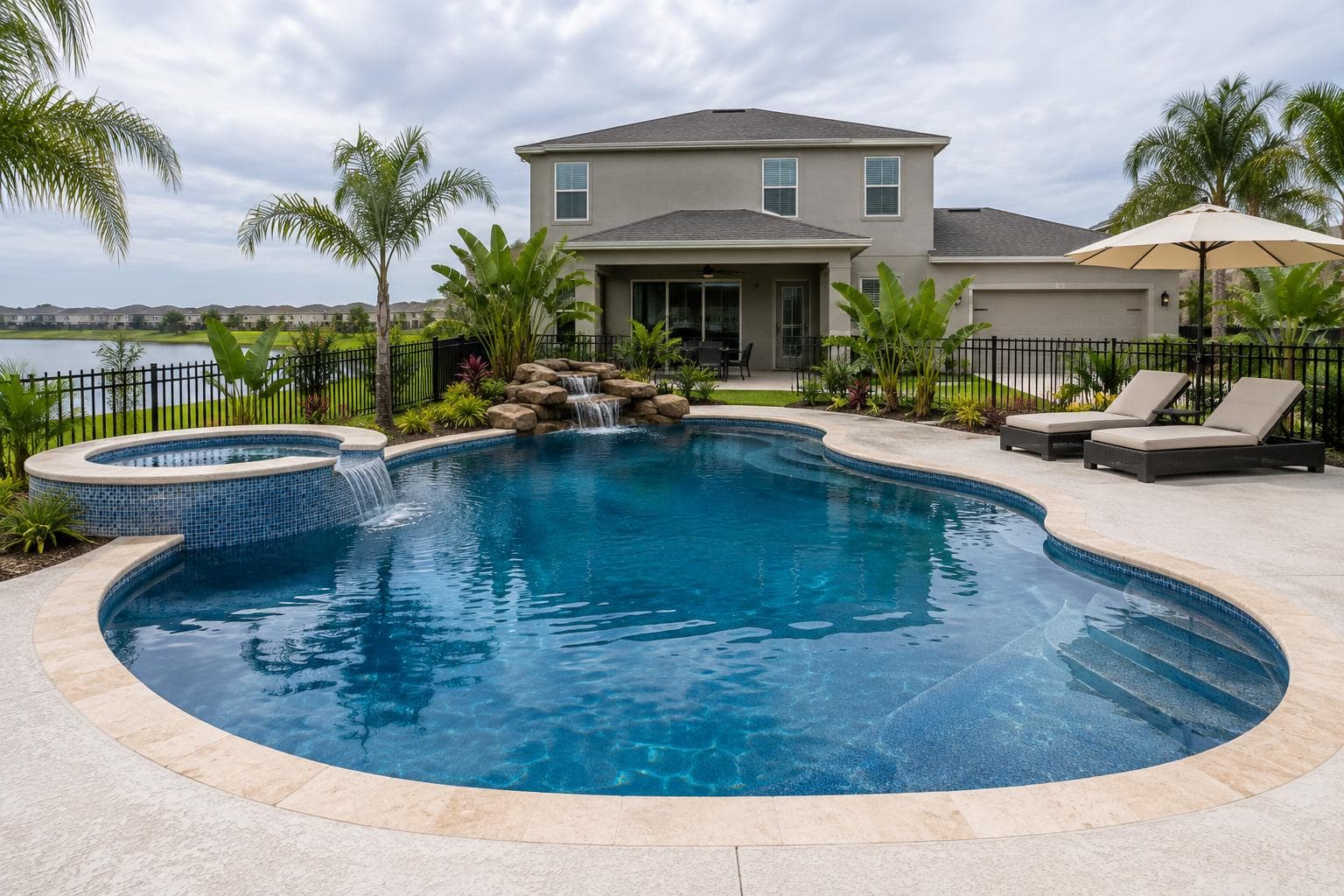
Freeform: soft, natural curves that fit an irregular yard
Latham describes freeform as an organic shape that can have dramatic curves for a modern look or a relaxed, wavy outline that gives the most swimming space. It says the range of sizes and styles can fit any backyard design.
Poolonomics calls it a pool of any shape or size with curves, also sold as lagoon, Key West or pond style, and says the only limit is your land and your budget.
- Looks like
- Organic, built from curves.
- Suits
- A natural, informal yard and a lot where a straight pool would feel forced.
- Mind this
- If you want to swim laps, ask the builder how long the longest straight run is.


Every picture is an AI concept image of a design idea, not a built pool. Each is drawn from one angle, so open the design to turn its 3D model and see the whole outline.
Kidney: a classic curve that works in a smaller space
Latham describes a kidney pool as rounded at each end and curving inward along one side, with an asymmetrical shape that suits smaller spaces and a contemporary look. It can include swim-up seating and slip-resistant steps.
Pool Research and Poolonomics both say the curves suit a waterfall or fountain, because the water circulates instead of crashing against the edge. Pool Research also lists a straight kidney, with a straight back that makes laps easier than a traditional kidney.
- Looks like
- A bean: rounded ends and one side curving in.
- Suits
- A smaller yard, and a pool with a waterfall or fountain.
- Mind this
- For laps, ask about a straight kidney. Pool Research says its straight back makes laps easier than a traditional kidney.


Geometric: straight lines and angles, from a plain rectangle to cut corners
Poolonomics describes geometric pools as having no curves, with sharp lines and angles that can run in any direction. It says they suit an owner who wants a tight space filled tastefully, or a large open yard turned into a feature, and that they are highly customizable.
Pool Research calls the rectangle the easiest to install, which can lower the cost, and not the most creative shape. It describes the Grecian, a rectangle with its corners softened, as a timeless look that can be a bit smaller than a rectangle pool. The visualizer draws it with the corners cut at 45 degrees.
- Looks like
- Straight edges and crisp corners, or a rectangle with its corners cut off.
- Suits
- A tight space filled tastefully, a large open yard made into a feature, and, for a plain rectangle, laps.
- Mind this
- Pool Research says the cut-corner version can be a bit smaller than a rectangle, so ask what that does to your water volume.


L-shaped: one arm for swimming, one for the kids
Latham says an L-shaped pool easily separates the shallow end from the deeper end, can include a tanning ledge or a wading area, and works when the pool has to wrap around an immovable feature or a landscaping element. It comes in a true L with hard lines or a lazy L with curves.
Poolonomics adds that an L suits an oddly shaped backyard or a courtyard, and that it can serve as a lap pool and a lounge pool at once. A hot tub in the empty corner can make the whole outline a rectangle again.
- Looks like
- A long swim lane with a shorter wing at one end.
- Suits
- Families, courtyards, and a yard with a tree or a patio the pool must go around.
- Mind this
- Each picture is one angle, so open the design and turn its 3D model to see the whole L.


Lagoon: a pool made to look like a pond, best for lounging
Pool Research describes a lagoon as a freeform pool that resembles a natural lagoon, often surrounded by plants and shrubs, for an owner who wants a natural look and mostly lounging. It says a lagoon is not ideal for swimming. A double lagoon has two sections jutting out and puts looks ahead of laps.
Poolonomics treats lagoon as another name for freeform. In the visualizer, freeform is drawn with soft, lagoon-like curves.
- Looks like
- A natural pond with planting right up to the edge.
- Suits
- Lounging and a natural look.
- Mind this
- Pool Research says it is not ideal for swimming.


Plunge: a small pool for cooling off, in any shape you like
Pool Research, which also calls it a dipping pool, describes a plunge pool as a small alternative to a standard pool, chosen when space is limited. Most are 6 to 12 feet wide and 8 to 22 feet long, the most common sizes are about 6 by 12 or 8 by 8 feet, and they are rarely deeper than six feet. It says you might not be swimming laps in one.
On cost, the same page says a concrete plunge pool runs at least $20,000 and closer to $40,000 depending on measurements. Our planning model uses $20,000 to $40,000 for a small concrete pool. A planning range from published sources, not a quote.
- Looks like
- A small pool, most 6 to 12 feet wide and 8 to 22 feet long.
- Suits
- A tight yard.
- Mind this
- You might not swim laps in one, and Pool Research says a concrete plunge pool starts at $20,000 and can run closer to $40,000.


Source: Pool Research, plunge pool cost
Questions people ask
What is the most popular pool shape?
The sources we use do not rank shapes by how many are built, so we cannot name one. Pool Research calls the rectangle the easiest to install, and Latham describes the kidney as a popular curved shape that suits smaller spaces.
What is the difference between a freeform pool and a kidney pool?
A kidney is one kind of freeform. Latham calls the kidney a popular freeform shape, rounded at each end and curving in along one side, while a freeform pool can take any organic outline.
What shape of pool is best for a small yard?
Latham says a kidney's asymmetrical shape suits smaller spaces, and Poolonomics says an L suits courtyards and odd lots. A plunge pool is the smallest option. Mark the outline on your lawn and check it against your town's setbacks before you choose.
What is a lagoon pool?
A freeform pool made to look like a natural lagoon, often with plants around the edge. Pool Research says it suits lounging more than swimming.
Can I see a pool shape in my own yard before I decide?
Yes. The free pool visualizer draws a rectangle, Roman end, freeform, kidney, L-shape or cut-corner pool on a photo of your yard. The result is an AI concept, not a design or a quote.
Sources and date checked
Links checked . If one has moved or no longer says this, tell us (see our editorial policy) and we will fix it.
Any cost range here is a planning range, not a quote. See how we write and check pages in our editorial policy.
Pool builder? Send a homeowner their own design as a film.
Not sure it will look right in your yard?
Add a photo of your yard to the free visualizer, pick what you are weighing, and look at the picture before you talk to a builder.